In the fields of oil and gas and water jetting, the selection of jetting equipment is crucial. Operations such as drilling, cementing, and pipeline pressure testing all require matching the pump type—reciprocating plunger pumps or centrifugal pumps—according to process characteristics.
1. Working Principle
Reciprocating plunger pumps are positive displacement pumps. They rely on the plunger's reciprocating motion within the cylinder to achieve liquid suction and discharge, and the flow rate basically does not change with discharge pressure. They are usually suitable for high pressure, low-flow conditions. Centrifugal pumps, on the other hand, are dynamic (impeller) pumps. They convert mechanical energy into kinetic and pressure energy through the high-speed rotation of impellers. Single-stage head is limited, making them typically suitable for medium-to-low pressure, large-flow conditions.
2. Core Requirements for Jetting
Jetting operations are characterized by high pressure, strict flow stability requirements, and media containing abrasive particles. Drilling and cementing require continuous injection of high pressure fluid into the wellbore within a short period; excessive pressure fluctuations can affect sealing reliability and operational safety. Pipeline pressure testing requires stable and controllable pressure to accurately interpret test results.
3. Differences Between Plunger Pumps and Centrifugal Pumps
| Plunger Pump | Centrifugal Pump | |
| Working Principle | Positive displacement | Dynamic (impeller) |
| Pressure | Suitable for high and ultra-high pressure conditions | Suitable for medium-to-low pressure conditions |
| Flow Rate | Relatively stable | Varies with pressure |
| Efficiency | Relatively high | Relatively low |
| Medium | Strong adaptability; can handle sand-laden, high-viscosity, abrasive, or chemical media | Suitable for low-viscosity, clean fluids; sensitive to solid particles |
| Applicable Conditions | High pressure water jetting, pressure testing, cementing | Water supply, transfer |
4. Why Plunger Pumps Are the Preferred Choice
The reason plunger pumps become the preferred choice under jetting conditions is primarily that their positive displacement working principle is highly aligned with operational requirements. With each reciprocating stroke of the plunger pump, the discharge pressure increases while the flow rate is almost unaffected. Moreover, the discharge pressure can be adjusted by changing the plunger diameter or adjusting the stroke. In addition, plunger pumps have strong tolerance for sand-laden, abrasive, and high-viscosity fluids, capable of meeting the continuous operation requirements under complex medium conditions such as drilling and cementing.
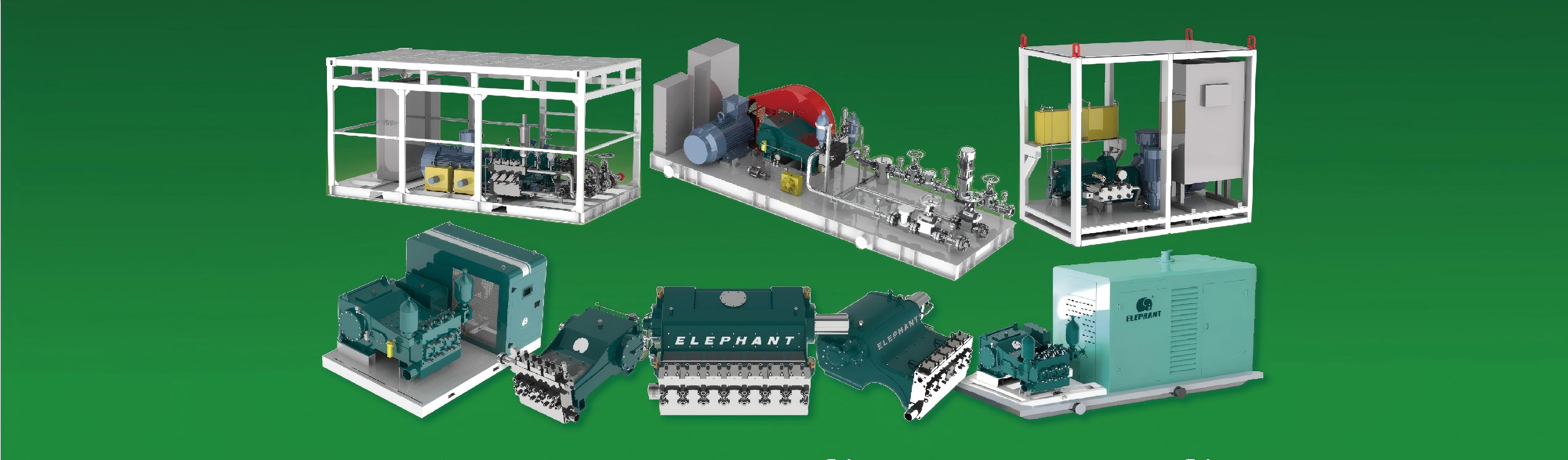
In summary, there is no absolute superiority or inferiority between plunger pumps and centrifugal pumps; the choice should be based on the operating conditions. Elephant Machinery primarily manufactures API 674 reciprocating pumps, covering triplex, quintuplex, and septuplex pumps, and supports customized solutions.