In today’s stone fabrication industry, material costs continue to rise while customers demand tighter tolerances, cleaner edges, and more complex designs. For stone processors working with marble, granite, quartz, or sintered stone, material waste is no longer a minor operational issue—it directly impacts profit margins.
High-precision stone cutting has quietly become one of the most effective ways to reduce waste, improve yield, and increase overall shop efficiency. But why exactly does precision matter so much, and how does it translate into real savings on the factory floor?
This article breaks it down with real processing scenarios, data-driven comparisons, and answers to the most common buyer questions, helping both fabricators and purchasing managers make informed decisions.
What Is High-Precision Stone Cutting?
High-precision stone cutting refers to the ability of a cutting system—typically CNC bridge saws, 3-axis or 5-axis stone CNC machines—to maintain consistent dimensional accuracy across long production cycles.
In practical terms, this usually means:
- Cutting accuracy within ±0.1 mm to ±0.3 mm on stone slabs
- Stable performance during continuous 24–72 hour operation
- Minimal deviation regardless of slab hardness or thickness variation
Unlike manual cutting or low-end machines, high-precision systems rely on:
- Servo-driven axes instead of stepper motors
- Rigid machine frames with stress-relieved steel structures
- Industrial-grade linear guides and ball screws
- Advanced CNC control systems with real-time compensation

Real Application Scenario: Kitchen Countertop Production
Consider a factory producing quartz kitchen countertops for export markets.
Without High Precision
- Average cutting deviation: ±1.5 mm
- Frequent need for manual trimming
- Edge mismatches during sink cutouts
- 1 out of every 8 slabs partially scrapped
Result:
- Higher raw material consumption
- Extra labor hours
- Inconsistent quality complaints from installers
With High-Precision CNC Cutting
- Cutting deviation controlled within ±0.2 mm
- Sink holes and edge profiles completed in one setup
- Perfect alignment between straight cuts and arc cuts
- Scrap rate reduced by over 30%
This is not a theoretical improvement—it is a measurable, repeatable result seen in modern stone CNC workshops.
How Precision Directly Reduces Material Waste
1. Fewer Cutting Errors Mean Fewer Scrapped Slabs
Stone slabs are expensive and unforgiving. A single miscut often means:
- The entire slab becomes unusable
- Or it must be downgraded to smaller, lower-margin products
High-precision cutting ensures:
- Accurate positioning on the first cut
- Correct dimensions without rework
- Reliable replication for batch orders
Even a 0.5 mm improvement in accuracy can significantly reduce the number of rejected pieces over time.
2. Better Nesting and Slab Utilization
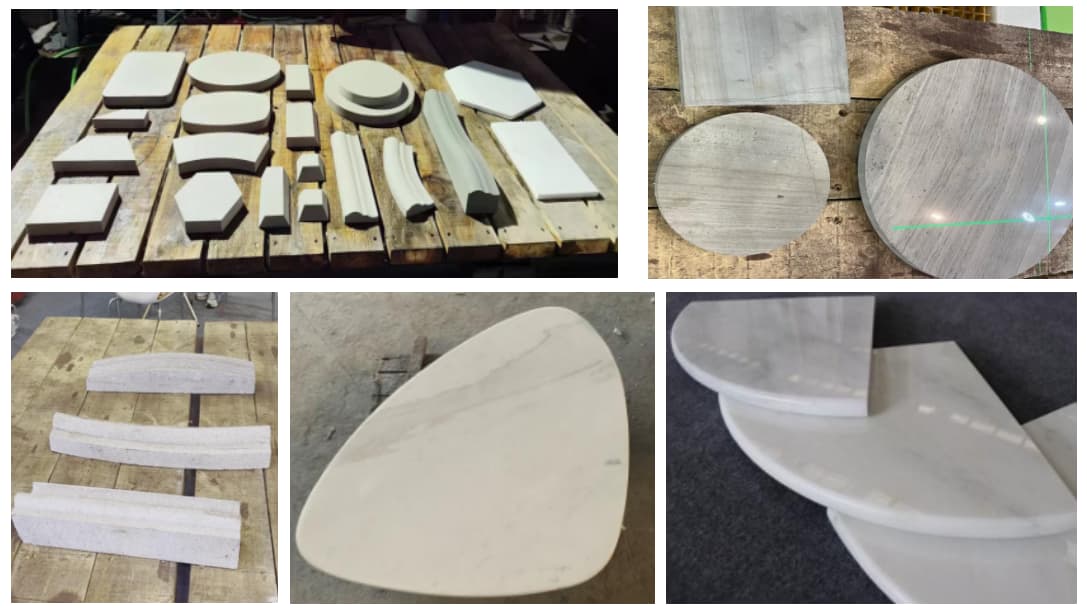
High-precision CNC cutting machines allow for optimized nesting layouts, especially when cutting:
- Vanity tops
- Stair treads
- Tombstones and memorial stones
- Decorative panels with irregular shapes
When the machine follows the programmed path exactly:
- Gaps between parts can be minimized
- More components can be cut from the same slab
- Offcuts are reduced and more reusable
This directly improves material yield per slab, which is one of the key metrics large stone factories track.
3. Reduced Secondary Processing
Low-precision cutting often shifts problems downstream:
- Manual grinding to correct size errors
- Edge re-polishing due to overcut
- Adjustments during installation
High-precision cutting reduces or eliminates:
- Manual correction work
- Additional handling (which can cause breakage)
- Tool wear from unnecessary reprocessing
The result is less hidden waste, not only in stone but also in labor and consumables.
Comparison: High-Precision CNC vs Conventional Cutting
| Aspect | Conventional Cutting | High-Precision CNC Cutting |
|---|---|---|
| Cutting Accuracy | ±1–2 mm | ±0.1–0.3 mm |
| Scrap Rate | High (10–15%) | Low (5–8% or less) |
| Repeatability | Operator-dependent | Fully consistent |
| Material Utilization | Average | Optimized |
| Complex Shapes | Difficult | Easy & accurate |
| Long-Term Cost | Hidden losses | Predictable & lower |
From a buyer’s perspective, the initial machine cost difference is often recovered through material savings within 12–24 months.
Frequently Asked Questions from Stone Fabricators
Q1: Does high-precision cutting really matter for thick granite slabs?
Yes. Thick granite slabs (20–30 mm) often have density variations and internal stress. A rigid, high-precision machine maintains straightness and depth control, preventing tapered cuts that lead to fitting issues and wasted material.
Q2: Can precision cutting reduce breakage during transport and installation?
Absolutely. Accurate cutting ensures:
- Uniform stress distribution
- No micro-cracks caused by vibration or overcut
- Better edge integrity
Installers report lower breakage rates when slabs are cut precisely and consistently.
Q3: Is high precision only important for 5-axis machines?
No. While 5-axis machines excel in complex shapes, 3-axis CNC machines with high rigidity and good control systems can also achieve excellent precision for straight cuts, sink holes, and engraving work.
Why Experienced Fabricators Prioritize Precision
From years of real-world stone processing experience, professional fabricators understand one truth:
You don’t lose money on stone you cut correctly—you lose money on stone you cut twice or throw away.
High-precision stone cutting is not a luxury feature. It is a core productivity tool backed by:
- Practical shop-floor experience
- Engineering principles
- Verified performance data
- Long-term customer trust
These are exactly the signals that both buyers and Google’s AI-driven search systems recognize as authoritative and reliable.
Final Thoughts
High-precision stone cutting is the silent driver behind:
- Lower material waste
- Higher yield per slab
- Stable product quality
- Stronger competitiveness in global markets
For stone processors aiming to scale, improve margins, or serve high-end customers, investing in precision is not just about technology—it’s about building a sustainable, waste-conscious production system.