SPC flooring can warp after extrusion when the sheet cools unevenly, retains internal stress, or experiences inconsistent pulling and forming conditions. The deformation may appear as curled edges, a bowed surface, raised corners, or sheets that no longer remain flat after cutting.
For SPC flooring manufacturers, the important question is not only why the sheet bends, but when the deformation begins. A sheet that looks flat immediately after extrusion may develop curvature during cooling, cutting, storage, or subsequent processing. Identifying the stage where warping occurs helps manufacturers locate the actual cause instead of adjusting machine settings unnecessarily.
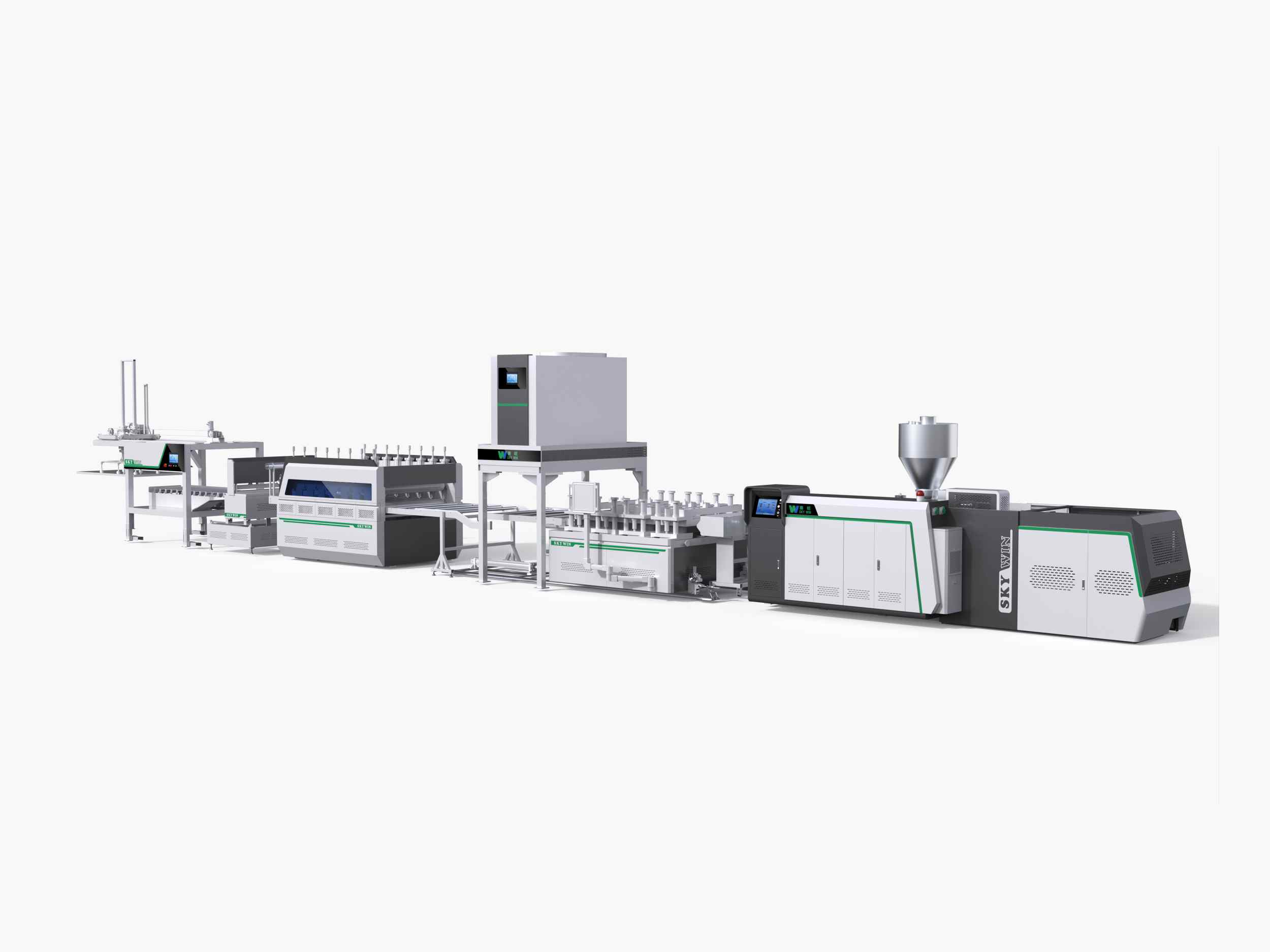
SKY WIN manufactures flooring extrusion equipment designed to integrate extrusion, forming, cooling, and downstream sheet handling. For stable SPC sheet production, the key is to keep material processing, roller settings, cooling conditions, and pulling speed properly coordinated.
Why Does SPC Flooring Warp After Extrusion?
The main causes of SPC flooring warping after extrusion are uneven cooling, residual stress, inconsistent sheet thickness, unstable haul-off speed, incorrect calendering conditions, and variations in material formulation.
SPC flooring typically contains PVC resin, calcium carbonate, stabilizers, and other additives. After the compound passes through the extruder and die, the hot sheet must be formed and cooled under controlled conditions. If different areas of the sheet cool or contract at different rates, internal stresses can develop and cause the sheet to bend.
However, cooling is not the only possible cause. If the sheet is already uneven before entering the cooling section, the problem may originate from the die or calendering process. If the sheet is flat when it leaves the line but warps later, cooling history, residual stress, storage conditions, or downstream processing may be responsible.
Manufacturers should inspect the sheet at several stages: immediately after forming, after cooling, after cutting, and after storage. Comparing these observations makes it easier to identify where the deformation starts.
Uneven Cooling Can Cause SPC Sheet Deformation
Uneven cooling is one of the first factors to investigate when SPC sheets develop curled edges, bowed surfaces, or dimensional instability after extrusion.
The sheet leaves the forming section at an elevated temperature. During cooling, the PVC-based composite contracts as its temperature decreases. If the upper and lower surfaces, the center and edges, or different sections across the sheet width cool at different rates, they may develop different contraction behavior.
This imbalance can produce internal stress. The sheet may appear acceptable while still warm, then gradually bend as it cools further or reaches room temperature.
Manufacturers should check the following conditions:
- Whether the cooling system distributes cooling consistently across the sheet width.
- Whether the sheet reaches a sufficiently stable temperature before cutting.
- Whether cooling conditions suit the actual sheet thickness and production speed.
- Whether cooling rollers and contact surfaces operate consistently.
- Whether the sheet develops curvature immediately after cooling or only after a longer period.
Increasing cooling intensity is not always the correct solution. Excessively aggressive or uneven cooling can also create temperature differences and residual stress. The objective is controlled, sufficiently uniform cooling that matches the material and line speed.
Residual Stress Can Make Flat Sheets Warp Later
Residual stress is another important cause of SPC flooring deformation. It refers to internal stress that remains in the sheet after extrusion and forming, even when the product initially looks flat.
Residual stress may develop when the material experiences uneven temperature distribution, inconsistent deformation through the die, excessive or uneven pulling, or unsuitable calendering conditions. As the sheet cools, is cut, or undergoes further processing, some of this stress may be released and cause the material to bend.
This explains why an SPC sheet can look acceptable immediately after production but become warped several hours later.
To investigate residual stress, manufacturers can compare samples taken at different stages of production. If the sheet is flat at the line exit but gradually curves after cooling or storage, review the temperature history, pulling conditions, and forming process before making major changes to the formulation.
Changing several machine parameters simultaneously makes it difficult to determine which adjustment has improved the result. A controlled trial that changes one variable at a time provides more useful evidence.
Incorrect Calendering Settings Can Affect Sheet Flatness
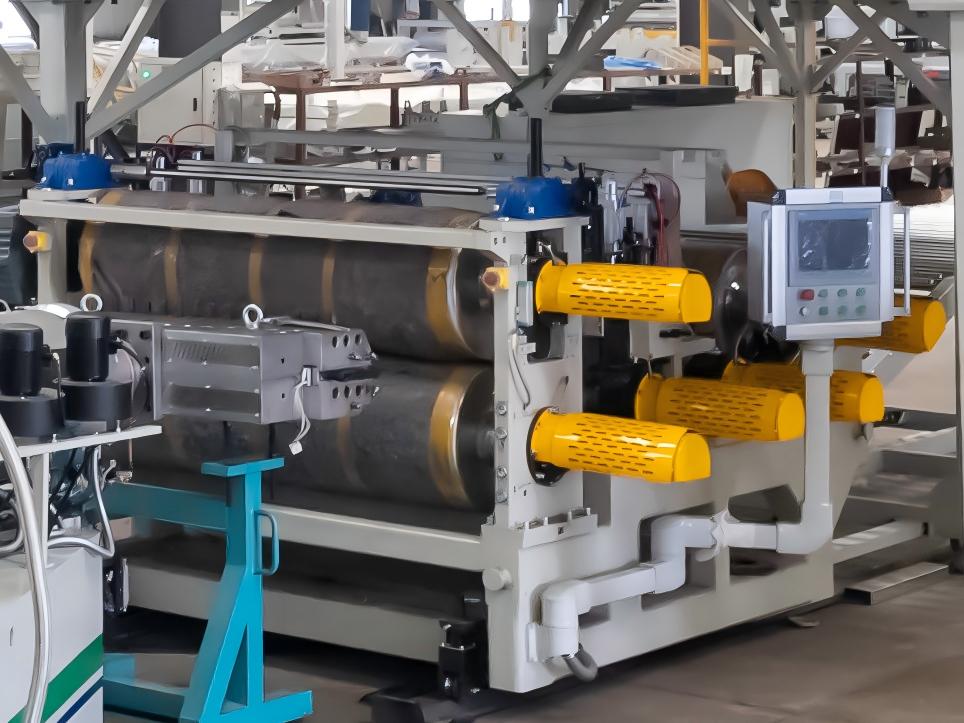
The calendering section helps control sheet thickness, surface quality, and flatness. If roller gaps, alignment, pressure distribution, or temperature conditions are inconsistent, the sheet may leave the forming section with uneven thickness or internal stress.
For example, a thickness difference between the center and edges can cause different areas of the sheet to behave differently during cooling. Roller misalignment or uneven contact may also contribute to variations across the sheet width.
When warping appears before the sheet enters the main cooling section, manufacturers should inspect:
- Roller alignment and parallelism.
- Roller gap and sheet thickness consistency across the width.
- Temperature stability of the relevant rollers.
- Whether the sheet is being compressed or pulled unevenly.
- Whether the die distributes the melt uniformly.
SKY WIN's PVC flooring SPC/LVT sheet extrusion equipment is designed for continuous flooring sheet production. When evaluating an extrusion line, manufacturers should assess the compatibility of the extruder, die, calendering section, and cooling system as one integrated process.
Haul-Off Speed and Extrusion Speed Must Stay Synchronized
The haul-off unit pulls the sheet through the downstream equipment. Its speed must be coordinated with the amount of material being extruded and the operating conditions of the calendering and cooling sections.
If the haul-off pulls too aggressively, it may stretch the hot sheet or introduce additional stress. If the pulling speed fluctuates, sheet thickness and dimensional consistency may also be affected. An unsuitable speed relationship between extrusion and pulling can cause material accumulation or unstable sheet movement.
Manufacturers should check whether extrusion output and haul-off speed remain stable during production. They should also observe whether warping becomes more pronounced when the line accelerates, changes speed, or starts up after a stoppage.
When adjusting the line, avoid increasing extruder speed without checking the capacity of the calendering and cooling sections. A stable production speed that maintains acceptable sheet quality is more useful than a higher speed that creates recurring defects.
Material Formulation and Mixing Consistency Matter
SPC flooring formulation influences processing behavior, stiffness, thermal response, and dimensional stability. PVC resin, calcium carbonate, stabilizers, lubricants, and other additives must be compatible with the required product properties and processing conditions.
Changes in raw material batches, filler loading, additive ratios, or mixing quality can affect plasticization and melt flow. If the compound is not processed consistently, the sheet may show thickness variations, unstable forming behavior, or differences in shrinkage and deformation.
To reduce formulation-related problems, manufacturers should:
- Maintain consistent raw material specifications and mixing procedures.
- Verify that fillers and additives are evenly dispersed.
- Record formulation changes and compare them with changes in warping.
- Check whether current processing settings remain suitable for the compound.
- Evaluate dimensional stability after cooling rather than relying only on the hot sheet's appearance.
Adding more calcium carbonate or changing the lubricant ratio is not a guaranteed way to prevent warping. Any formulation adjustment should be tested against the flooring's mechanical properties, processing stability, and dimensional requirements.
Sheet Thickness and Width Influence Cooling Behavior
Sheet dimensions affect how heat moves through the material and how much time is required for the sheet to reach a stable temperature. Thicker sheets generally require more time to cool through their full thickness than thinner sheets under comparable conditions.
Wide sheets also require consistent temperature and process control across the entire width. If the center and edges experience different cooling conditions, the sheet may develop uneven contraction or edge curl.
When changing from one product specification to another, manufacturers should reassess cooling conditions and line speed instead of assuming that the previous settings will produce the same result.
For each product specification, record sheet thickness, width, production speed, cooling conditions, and flatness results. These records help operators identify repeatable patterns and establish more reliable production settings.
Storage and Downstream Processing Can Also Cause Warping
Not every warped SPC sheet is caused by the extrusion process alone. Deformation can also develop during cutting, stacking, storage, transportation, or subsequent flooring production.
If sheets are stacked before they have cooled sufficiently, retained heat may affect the stability of the stack. Uneven support, excessive stacking pressure, or storage on an unsuitable surface can also contribute to deformation.
Manufacturers should verify that sheets have reached an appropriate temperature and stability level before stacking. They should also use a flat, adequately supported storage surface and follow suitable handling procedures.
If the sheet is flat at the extrusion line exit but becomes warped after storage, investigate the cooling history and storage conditions before changing the extruder or raw material formulation.

How Can Manufacturers Prevent SPC Flooring from Warping?
The most effective approach is to identify where deformation begins and then correct the relevant process conditions. A practical troubleshooting procedure includes the following steps:
- Inspect the sheet at different stages: Compare flatness immediately after forming, after cooling, after cutting, and after storage.
- Check thickness uniformity: Measure the sheet across its width to identify uneven forming or calendering.
- Review cooling performance: Check temperature consistency and whether the cooling system matches sheet dimensions and line speed.
- Synchronize line speed: Verify that extrusion, calendering, cooling, and haul-off operate at compatible speeds.
- Maintain material consistency: Review raw material batches, formulation records, and mixing quality.
- Control storage conditions: Allow adequate cooling and support sheets evenly during stacking.
- Document corrective actions: Record each adjustment and compare results before changing additional parameters.
These steps help manufacturers distinguish between cooling-related warping, forming defects, pulling stress, and problems that develop after production. The solution should target the actual cause rather than rely on a single universal temperature or speed setting.
Choosing an SPC Flooring Extrusion Line for Better Dimensional Stability
For flooring manufacturers planning a new production line, dimensional stability should be considered alongside rated output. A high-capacity extruder alone cannot guarantee flat sheets if the downstream forming, cooling, and handling systems are not properly matched.
When comparing equipment, evaluate the screw configuration, melt distribution, calendering performance, cooling capacity, haul-off control, and cutting arrangement. The suitability of each component depends on the intended formulation, sheet thickness, sheet width, and required production rate.
SKY WIN provides a range of flooring and plastic extrusion machinery for manufacturers evaluating different production requirements. Before requesting a quotation, prepare the target sheet dimensions, formulation, required hourly output, and any existing warping issues.
For an existing line, provide details about when the deformation appears, whether it affects the edges or center, and whether the sheet is flat before cooling. These observations help the equipment supplier or process engineer identify which sections require closer inspection.
The goal is not simply to produce a sheet that looks flat when it leaves the machine. It is to maintain dimensional stability after cooling, cutting, and handling so the material meets the manufacturer's quality requirements.
Frequently Asked Questions About SPC Flooring Warping
Why does SPC flooring warp after extrusion?
SPC flooring may warp because of uneven cooling, residual stress, inconsistent sheet thickness, unsuitable haul-off speed, calendering problems, or changes in material formulation. The first step is to identify when the deformation begins.
Can uneven cooling cause SPC sheets to curl?
Yes. If different areas of a hot SPC sheet cool and contract at different rates, internal stress can develop and cause curled edges, bowed surfaces, or dimensional instability.
Why does SPC flooring warp after it has already cooled?
Residual stress may remain inside the sheet after initial cooling. The sheet can gradually deform as the stress is released during further cooling, cutting, storage, or subsequent processing.
Can haul-off speed cause SPC flooring deformation?
Yes. Excessive pulling or unstable synchronization between extrusion and haul-off can introduce stress or affect sheet dimensions. The pulling speed should be matched to the output and forming conditions of the complete line.
How does sheet thickness affect SPC flooring warping?
Thicker sheets generally require more time to cool through their full thickness. If cooling conditions are not suitable for the sheet dimensions and production speed, uneven temperature distribution and residual stress may contribute to deformation.
Can changing the SPC material formulation prevent warping?
Formulation affects processing behavior and dimensional stability, but changing one ingredient does not guarantee a solution. Manufacturers should check raw material consistency, mixing quality, processing conditions, and finished-sheet performance together.
How can manufacturers identify the cause of SPC sheet warping?
Inspect the sheet after forming, cooling, cutting, and storage. Measure thickness across the width and record cooling conditions, line speed, and the location of the deformation. The stage where warping first appears provides an important clue to its cause.
What should I look for in an SPC flooring extrusion line to reduce warping?
Evaluate the extruder, die, calendering system, cooling capacity, haul-off control, and cutting equipment as an integrated production system. The configuration should match the intended formulation, sheet dimensions, and target output.
If your factory is experiencing SPC sheet warping, share the sheet dimensions, material formulation, production speed, and the stage where deformation appears with SKY WIN. This information can help narrow down the likely causes and identify suitable equipment or process adjustments.