Choosing an SPC flooring extrusion line is an important decision for any factory planning to manufacture stone plastic composite flooring. The right production line needs to match the factory's target output, flooring specifications, raw material formulation, available space, and long-term production plans. A machine with a high rated capacity is not necessarily the best choice if its configuration does not match the products you intend to manufacture.
For flooring manufacturers, the goal is to build a production system that delivers consistent sheet quality, reliable operation, and a practical balance between equipment investment and manufacturing costs. SKY WIN provides extrusion equipment for SPC, LVT, and WPC flooring production, with configurations that can be evaluated according to different manufacturing requirements.
This guide explains the key factors to consider before purchasing an SPC flooring extrusion line, helping buyers compare technical specifications and make a more informed equipment investment.
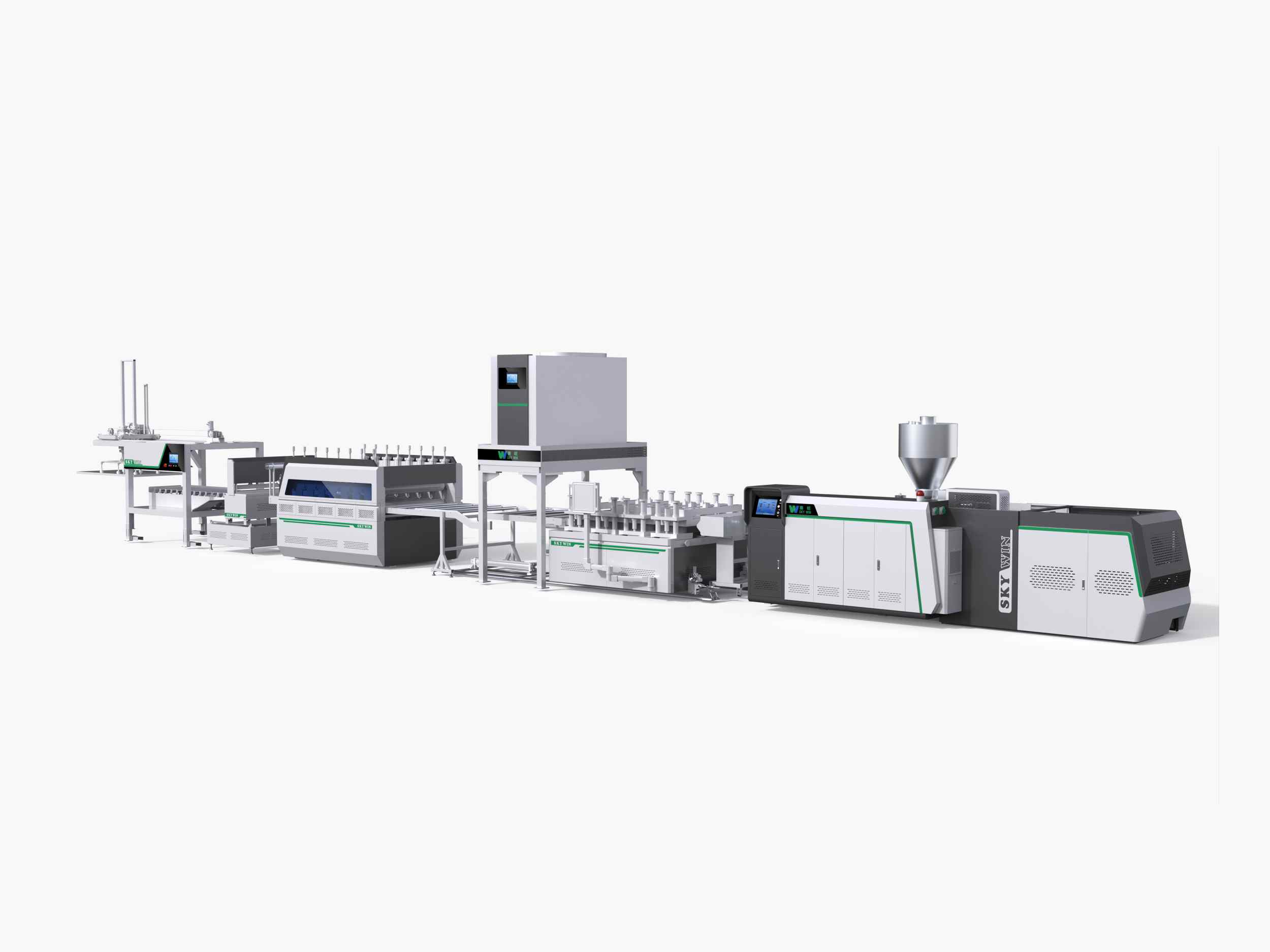
Define Your Flooring Products Before Selecting the Equipment
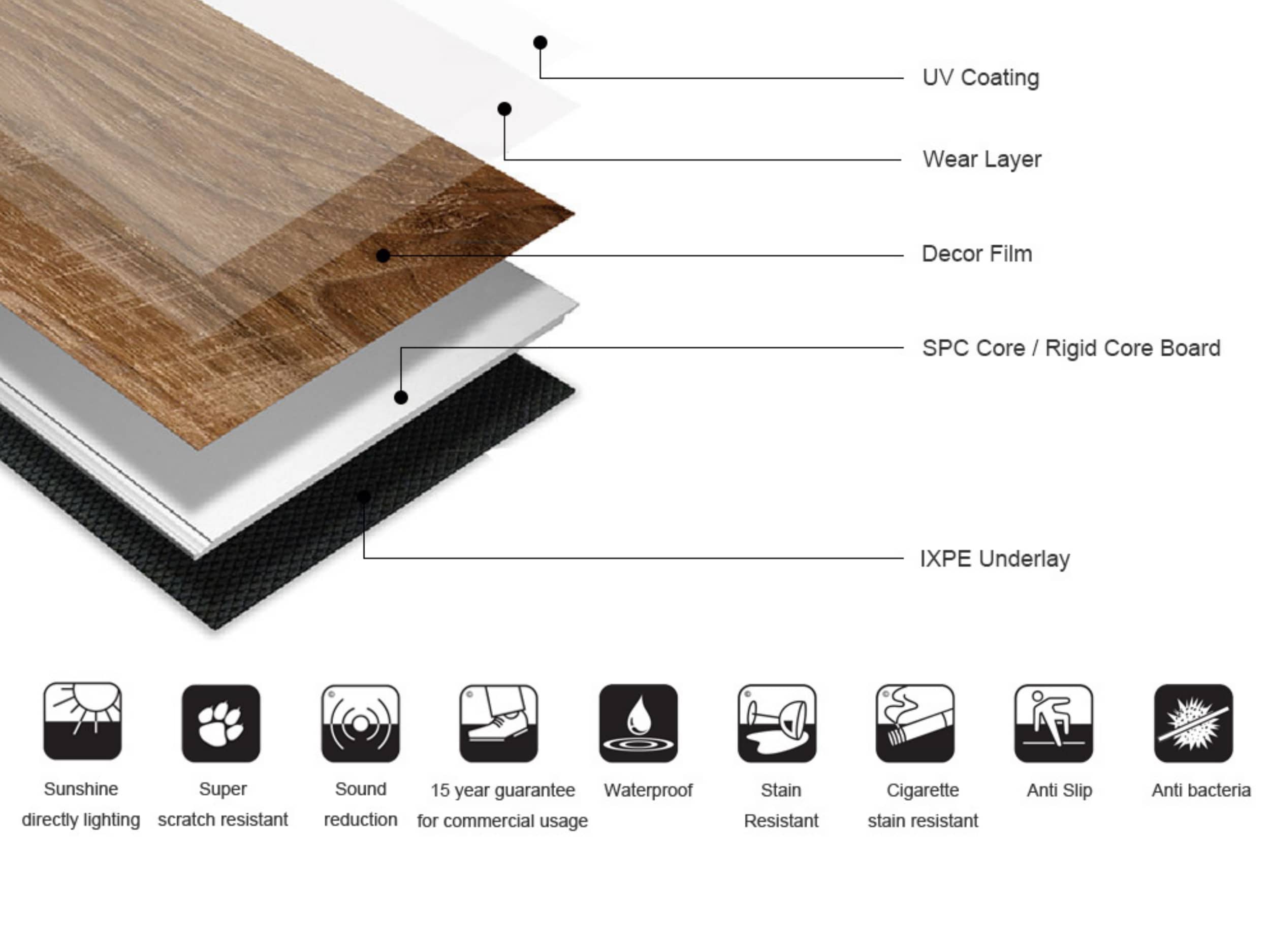
The first step is to determine exactly what the factory plans to produce. SPC flooring, LVT flooring, and WPC flooring may share some processing technologies, but their core materials, product structures, and processing requirements are different. These differences influence the extruder design, tooling, calendering system, cooling section, and downstream equipment.
SPC flooring typically uses PVC resin, calcium carbonate, stabilizers, and other additives to produce a rigid core sheet. LVT flooring can require a different material formulation and product structure, while WPC flooring may involve wood-plastic composite materials or foamed core formulations. Equipment suitability depends on the specific product design and processing conditions.
Before requesting a quotation, prepare the following information:
- Flooring type and intended product structure.
- Target sheet width and thickness range.
- Required production output under actual operating conditions.
- Raw material formulation and expected filler content.
- Whether online lamination, embossing, or other integrated processes are required.
- Available factory space and downstream processing requirements.
These details help the equipment supplier determine whether a standard configuration is suitable or whether a customized production line is needed. They also reduce the risk of comparing quotations that include different equipment and production capabilities.
Match Production Capacity to Your Actual Manufacturing Plan
Production capacity is one of the most important factors when choosing an SPC flooring extrusion line. However, the rated output shown in a specification sheet should not be treated as the guaranteed output for every product. Actual production depends on sheet thickness, width, material formulation, extrusion stability, operating speed, and the performance of downstream equipment.
SKY WIN's published SPC/PVC flooring sheet extrusion line specifications list several SWDB5 configurations. The published output ranges extend from 600–800 kg/h for the SWDB5-2 model to 3,000–4,000 kg/h for the SWDB5-6 model. The same product page lists sheet thicknesses of 1.5–7 mm and sheet widths of 970–1,220 mm for the series.
These figures provide a useful starting point for comparing equipment sizes, but buyers should confirm the output achievable with their intended formulation, finished sheet dimensions, and production conditions before selecting a model.
| Selection factor | What to confirm |
|---|---|
| Target output | Required hourly output for the actual flooring formulation and dimensions. |
| Sheet dimensions | Compatible width and thickness ranges for the intended products. |
| Operating schedule | Planned working hours, maintenance time, product changeovers, and startup waste. |
| Future demand | Expected sales growth and the cost of adding capacity later. |
It is usually more useful to compare achievable output under the same product conditions than to select equipment based on the highest advertised number. A properly matched line can help manufacturers balance throughput, product consistency, material consumption, and operating costs.
Evaluate the Extruder and Screw Configuration
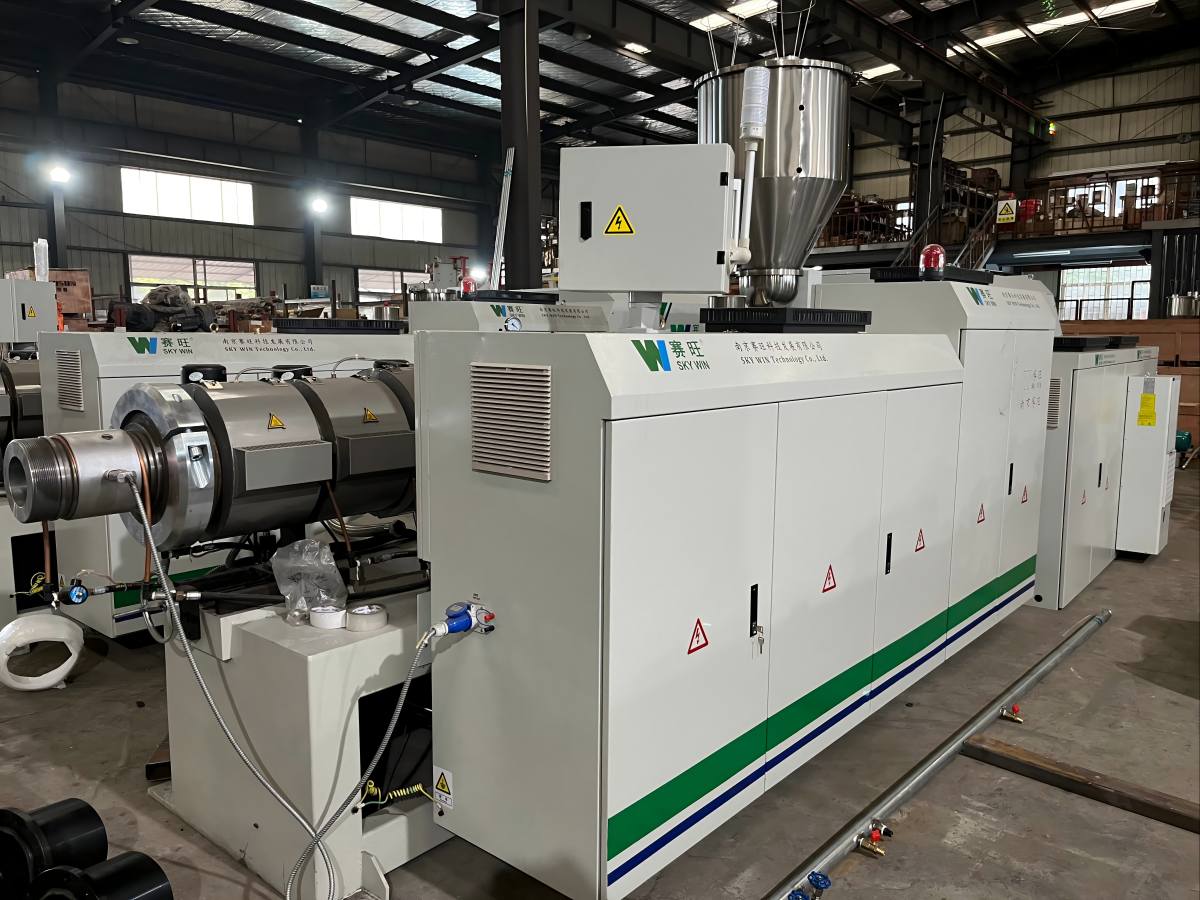
The extruder is the core of an SPC flooring production line. It must process the PVC-based compound consistently, provide suitable plasticization and mixing, and deliver a stable melt to the forming section. Screw geometry, torque, heating control, and wear resistance all influence performance.
SKY WIN's SPC/PVC flooring sheet extrusion line uses a conical twin-screw extruder. This configuration is designed for processing PVC-based composite materials containing calcium carbonate and other additives.
When reviewing an extruder, buyers should ask the supplier to explain how the screw design matches the planned formulation. A formulation containing a high proportion of mineral filler may place different demands on the screw and barrel than a formulation with a lower filler content.
Important points to verify include:
- Whether the screw configuration is suitable for the intended raw materials.
- How the heating and temperature control systems maintain stable processing conditions.
- What wear-resistant treatment or material options are available for the screw and barrel.
- How the extruder handles changes in formulation and production speed.
- Whether the supplier can provide processing recommendations and technical support.
Rather than choosing an extruder by motor power alone, compare the complete configuration and request technical confirmation for your target product. This helps establish whether the equipment can meet the required production conditions.
Check the Calendering, Cooling, and Lamination Systems
A suitable extruder is only one part of the production line. The downstream section also affects sheet thickness, surface appearance, cooling behavior, and the consistency of the finished flooring base.
Depending on the line configuration, downstream equipment may include a calendering system, online lamination equipment, embossing units, cooling support frames, edge trimming, haul-off equipment, and cutting systems. The specific combination should be selected according to the product structure and the required manufacturing process.
For example, SKY WIN's published SWDB5 equipment list includes a five-roll laminator, a laminating unit, an oil-heated roll system, cooling equipment, an edge trimmer, a haul-off unit, a high-speed sheet cutter, and an electrical control system.
When comparing suppliers, ask how the extruder and downstream units are synchronized. If the processing speed, temperature, cooling capacity, or material flow is not properly matched, the line may struggle to maintain consistent sheet dimensions and surface quality.
For factories that require a different base material configuration, the PVC/WPC flooring base material extrusion line is another option to evaluate. SKY WIN describes this system as integrating mixing, extrusion, calendering, cooling, and cutting for the production of flooring base sheets.
Consider Automation, Factory Space, and Operating Costs
Automation requirements should reflect the factory's production volume, labor availability, and quality control needs. A more integrated system may reduce manual handling, but the actual benefit depends on how well the equipment matches the manufacturing process.
When evaluating the electrical control system and automation options, ask whether operators can monitor key processing parameters, coordinate line speed, adjust operating settings, and identify production problems efficiently. Also confirm which functions are standard and which require additional equipment.
Factory space is another important consideration. The layout must accommodate the extruder, forming and cooling sections, cutting equipment, material handling, and safe access for operation and maintenance. Buyers should obtain the overall line dimensions and discuss the layout before finalizing the purchase.
Operating costs should be assessed alongside the initial equipment price. Relevant factors include energy consumption, raw material waste, maintenance requirements, spare parts, labor, and downtime. Request information based on comparable production conditions so that different equipment proposals can be evaluated fairly.
Evaluate the Supplier's Engineering and After-Sales Support
Purchasing an SPC flooring extrusion line is a long-term manufacturing investment. The supplier's technical experience, commissioning support, spare parts availability, and ability to troubleshoot production problems can affect how smoothly the factory starts and maintains production.
Before placing an order, ask the supplier to clarify:
- Which equipment and auxiliary systems are included in the quotation.
- Whether installation, commissioning, and operator training are available.
- What documentation and maintenance instructions are supplied.
- How technical support and spare parts are provided after delivery.
- Whether reference projects or relevant customer cases can be shared.
- What the warranty covers and which conditions apply.
SKY WIN presents its SPC, LVT, and WPC extrusion equipment as part of its flooring machinery portfolio. Its published SPC, LVT, and WPC flooring project case describes a long-term relationship with an international flooring manufacturer and equipment projects supporting expansion into Vietnam.
When reviewing a case study, focus on whether the customer's product requirements and production conditions are similar to your own. Ask for further technical details where available, rather than assuming that one project demonstrates identical performance under all manufacturing conditions.
Compare Equipment Proposals Before Making the Final Decision
Before selecting a supplier, prepare a consistent specification sheet and ask each manufacturer to quote against the same requirements. This makes it easier to identify differences in configuration, output assumptions, included equipment, and service scope.
A practical evaluation should cover the following areas:
- Product compatibility and raw material requirements.
- Verified output for the target sheet dimensions and formulation.
- Extruder, calendering, cooling, and cutting configurations.
- Automation functions and electrical components.
- Factory layout, installation requirements, and utility needs.
- Energy consumption, maintenance, and expected spare parts requirements.
- Delivery schedule, commissioning, training, and after-sales support.
For manufacturers comparing flooring technologies, it may also be useful to review SKY WIN's LVT flooring high-speed extrusion line. The product page provides a separate set of specifications for LVT production, helping buyers understand why the required configuration should be selected according to the intended flooring type.
The best SPC flooring extrusion line is not necessarily the largest or the most expensive. It is the system that meets the factory's production requirements, provides suitable process control, supports the intended product quality, and offers a practical long-term operating plan.
Frequently Asked Questions About SPC Flooring Extrusion Lines
What should I consider first when choosing an SPC flooring extrusion line?
Start with the flooring structure, target output, sheet dimensions, raw material formulation, and available factory space. These requirements determine the suitable extruder configuration and downstream equipment.
What is the typical output of an SPC flooring extrusion line?
Output depends on the machine model, formulation, sheet dimensions, and operating conditions. SKY WIN's published SWDB5 series lists model-dependent output ranges from 600–800 kg/h to 3,000–4,000 kg/h. Buyers should confirm achievable output for their specific product requirements.
Why is a conical twin-screw extruder used for SPC flooring?
A conical twin-screw extruder is designed to process PVC-based compounds and support mixing, plasticization, and continuous extrusion. Its suitability should be evaluated against the actual formulation, filler content, and required output.
Can an SPC flooring extrusion line produce LVT flooring?
Some equipment configurations may support different flooring products, but compatibility should not be assumed. Confirm the material formulation, product structure, tooling, lamination process, and downstream requirements with the equipment supplier before purchasing.
Which downstream equipment should be included in an SPC flooring production line?
Depending on the product and configuration, the line may require calendering, lamination, cooling, edge trimming, haul-off, cutting, and electrical control systems. The supplier should confirm which units are included and whether additional equipment is required for the intended process.
How can I compare quotations from SPC flooring extrusion line manufacturers?
Compare quotations against the same product specifications, output conditions, machine configuration, included auxiliary equipment, automation functions, installation scope, warranty, and after-sales support. A consistent comparison is more useful than comparing purchase prices alone.
What information should I provide when requesting an SPC flooring extrusion line quotation?
Provide the flooring type, raw material formulation, target sheet width and thickness, required output, planned operating schedule, factory layout, and automation preferences. This allows the supplier to recommend a configuration based on your actual production needs.
If you are planning a new flooring factory or upgrading an existing production line, share your product specifications, target output, and project requirements with SKY WIN. The technical team can help you evaluate a suitable SPC flooring extrusion configuration and clarify the equipment and support required for your project.