In SPC flooring production, the conical twin-screw extruder does more than push material through a die. It helps transform a PVC-based compound containing calcium carbonate and processing additives into a consistent melt that can be formed into a rigid flooring core sheet. If the compound is not mixed and plasticized properly, problems such as unstable output, uneven sheet thickness, rough surfaces, and inconsistent product quality can become harder to control downstream.
For flooring manufacturers planning a new factory or upgrading an existing line, understanding the extruder's role is an important step in choosing the right equipment. SKY WIN provides extrusion machinery for SPC, LVT, and other plastic flooring applications. The right configuration depends on the raw material formulation, target sheet dimensions, required production capacity, and the equipment used after extrusion.
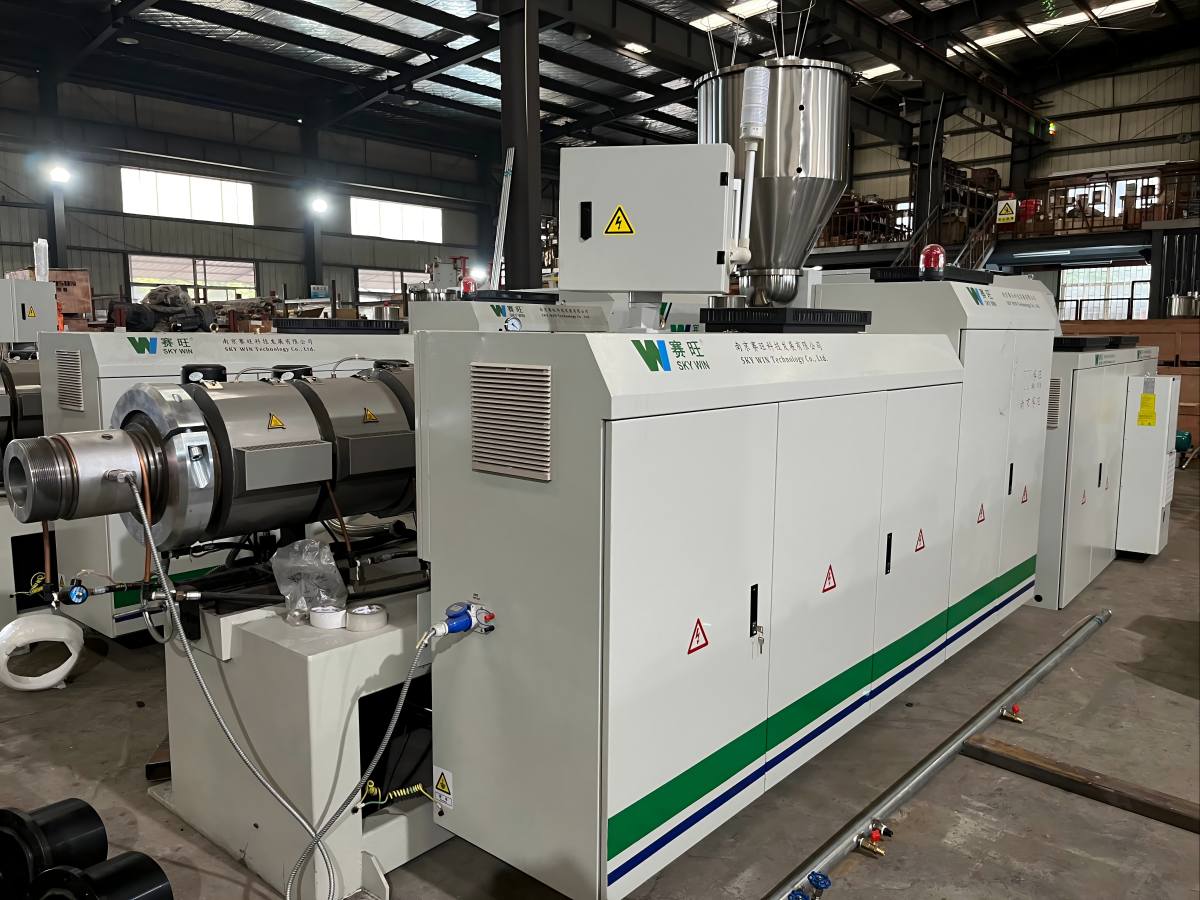
A conical twin-screw extruder is a key component in PVC-based flooring sheet production.
What Does a Conical Twin-Screw Extruder Do in SPC Flooring Production?
A conical twin-screw extruder processes the prepared SPC compound through controlled feeding, heating, mixing, and plasticization. It then delivers the processed material to the extrusion die, where the material is distributed into a continuous sheet. The sheet continues through downstream equipment for thickness control, lamination when required, cooling, trimming, and cutting.
SPC flooring commonly uses PVC resin, calcium carbonate, stabilizers, and other additives. Because the compound contains mineral filler, the extruder must be selected for the material formulation and production target rather than output alone.
The main functions of a conical twin-screw extruder include:
- Mixing and material dispersion: Helps distribute PVC resin, mineral filler, and additives throughout the compound.
- Plasticization: Applies heat and mechanical energy to prepare the compound for continuous extrusion.
- Stable material delivery: Supplies processed material to the die when feeding and operating conditions are properly controlled.
- Continuous production: Supports continuous sheet forming when the extruder is matched with the die, calendering system, cooling equipment, and downstream units.
The extruder is central to the production process, but it does not determine finished flooring quality by itself. Material preparation, die design, roller settings, cooling, and downstream handling all contribute to the final result.
Why Is a Conical Twin-Screw Design Used for SPC Compounds?
A conical twin-screw extruder has two screws arranged in a conical configuration. In PVC processing, this design can provide the conveying, mixing, and plasticizing characteristics required for rigid PVC-based compounds. Its suitability for SPC production depends on the screw geometry, torque, temperature control, material formulation, and required output.
Calcium carbonate is an important mineral filler in many SPC formulations. Its proportion and particle characteristics influence the compound's processing behavior and can increase the demands placed on screw and barrel components. Equipment selection should therefore consider both the formulation and the expected production conditions.
When comparing machinery, manufacturers should review the SKY WIN flooring extrusion machine range and identify which equipment configuration best fits their intended product. Before confirming a model, buyers should discuss the PVC resin, calcium carbonate loading, additive package, sheet width, thickness, and target output with the supplier.

Screw configuration, drive capacity, and temperature control should match the intended material and production conditions.
How Does the Extruder Affect SPC Flooring Sheet Quality?
When SPC flooring manufacturers investigate sheet defects, the extruder is one of the first areas to review. However, a visible defect does not always originate in the extruder itself. The cause may involve the formulation, feeding system, die, calendering rollers, cooling section, or the interaction between several stages.
Uneven sheet thickness: Fluctuations in feeding, melt flow, die conditions, or roller settings can contribute to thickness variation. Checking extrusion stability together with the forming and calendering systems helps identify the actual cause.
Rough or inconsistent surfaces: Poor dispersion, unsuitable processing temperatures, material contamination, or die-related issues can affect surface appearance. A stable and properly plasticized compound is an important starting point.
Unstable production output: Inconsistent raw material feeding, formulation changes, or processing conditions may cause output fluctuations. Increasing screw speed without checking downstream capacity can create further instability rather than solve the problem.
Dimensional variation after cooling: The extruder supplies the material, but final sheet stability also depends on calendering, cooling conditions, line speed, and how the sheet is handled after forming.
For this reason, manufacturers should evaluate the extrusion line as a connected system. A well-matched extruder and downstream configuration is generally more useful than choosing the largest machine available and expecting every process issue to disappear.
How Does the Extruder Work With the Rest of an SPC Flooring Line?
The extruder is only one stage in SPC flooring production. Its performance must be coordinated with the other equipment to maintain continuous processing and consistent sheet dimensions.
| Production stage | Main role | What manufacturers should check |
|---|---|---|
| Material preparation | Prepares a consistent PVC-based compound. | Formulation, mixing uniformity, feeding consistency, and material condition. |
| Conical twin-screw extrusion | Mixes and plasticizes the compound for continuous processing. | Screw configuration, torque, temperature control, and material compatibility. |
| Die and calendering | Forms the sheet and helps control thickness and surface quality. | Die distribution, roller settings, sheet dimensions, and line speed. |
| Lamination and embossing | Applies decorative layers or surface texture when included in the line. | Layer compatibility, bonding conditions, and surface pattern consistency. |
| Cooling, trimming, and cutting | Stabilizes the sheet and prepares it for subsequent processing. | Cooling capacity, sheet handling, edge quality, and cutting accuracy. |
SKY WIN's PVC Flooring SPC/LVT Sheet Extrusion Line is a related option for manufacturers comparing flooring sheet production equipment. The selected configuration should be checked against the planned flooring structure, sheet dimensions, and required production capacity.
What Should Buyers Check When Selecting an SPC Flooring Extruder?
The right conical twin-screw extruder is the one that matches the planned product, formulation, and production target. Buyers should compare the complete machine configuration rather than relying on a single specification.
- Target output: Confirm the required hourly output and ask whether the stated capacity applies to your intended formulation and sheet dimensions.
- Sheet width and thickness: Specify the required dimensions and verify that the extruder, die, calendering system, and downstream equipment are designed for them.
- Material formulation: Provide details about PVC resin, calcium carbonate content, stabilizers, lubricants, and other additives where available.
- Drive and temperature control: Review the main motor, operating controls, heating zones, and how the machine is intended to run under your production conditions.
- Wear resistance and maintenance: Ask about screw and barrel materials or treatments, maintenance intervals, spare parts, and technical support.
- Downstream compatibility: Check that the die, calendering rollers, cooling system, lamination unit, and cutting equipment can handle the planned line speed and output.
SKY WIN publishes different SWDB5 configurations with varying extruder sizes and rated output ranges. Its published specifications list 600–800 kg/h for SWDB5-2 and 3,000–4,000 kg/h for SWDB5-6. These are model-specific published figures, not a guarantee of output for every formulation or operating condition. Buyers should request technical confirmation for their own product specifications before making a final decision.
For projects involving PVC or wood-plastic composite flooring base sheets, the PVC/WPC Flooring Base Material Extrusion Line is another option to evaluate. The appropriate line depends on the actual material system, the intended flooring structure, and the finished sheet requirements.
How Can Manufacturers Improve Extrusion Stability?
Stable SPC production begins with consistent materials and a process that is properly matched to the equipment. Manufacturers can start by keeping the formulation and mixing procedure consistent between batches, monitoring feeding behavior, and recording key operating conditions during production.
When defects appear, it is useful to review the issue systematically rather than changing several machine settings at once. Check whether the problem began after a material change, a speed adjustment, a temperature change, or maintenance work. Then inspect the extruder and the relevant downstream stages to determine where the process first deviates from normal operation.
Regular inspection of screw and barrel wear, heating and cooling systems, drive components, and control systems also supports reliable operation. Maintenance requirements depend on the machine design, operating hours, material formulation, and production conditions, so the supplier's recommendations should be followed.
For a new production project, preparing the target sheet width, thickness, formulation, expected output, lamination requirements, and available factory utilities before requesting a quotation can make equipment discussions more precise. It also helps the supplier assess the complete line rather than sizing the extruder in isolation.
How Does SPC Extrusion Equipment Differ From LVT Production Equipment?
SPC and LVT flooring can both use PVC-based materials, but their core structures and processing requirements are not identical. SPC flooring typically uses a rigid composite core with a substantial mineral filler content, while LVT products can have different layer structures and flexibility requirements. Equipment should therefore be selected according to the intended flooring construction rather than assuming one production setup will suit every product.
For manufacturers considering a separate LVT production project, SKY WIN's LVT Flooring High-speed Extrusion Line provides a product-specific reference. Buyers should compare the material formulation, target sheet thickness, production speed, and downstream finishing requirements before deciding whether a line is suitable for their products.
Why Consider SKY WIN for Flooring Extrusion Equipment?
SKY WIN provides extrusion equipment for SPC, LVT, WPC, and other plastic processing applications. When evaluating a machine, manufacturers should look beyond the extruder itself and consider how the proposed configuration supports the complete production process, including sheet forming, cooling, lamination where required, and cutting.
Before discussing a project with an equipment supplier, prepare the planned formulation, sheet dimensions, target output, surface or lamination requirements, and expected operating schedule. These details help establish a more practical basis for selecting a machine configuration and confirming its suitability.
Review the available flooring equipment and discuss your production requirements with SKY WIN to identify a configuration suited to your intended product.
Frequently Asked Questions About Conical Twin-Screw Extruders for SPC Flooring
What is the role of a conical twin-screw extruder in SPC flooring production?
A conical twin-screw extruder mixes and plasticizes the PVC-based compound, which commonly contains calcium carbonate and processing additives. It supplies the processed material to the extrusion die for continuous sheet forming.
Why is a twin-screw extruder used for SPC flooring?
A twin-screw configuration can provide the conveying, mixing, and plasticizing performance needed for PVC-based compounds containing mineral fillers. The suitable design depends on the formulation, required output, and operating conditions.
What materials are used in SPC flooring extrusion?
SPC flooring compounds commonly contain PVC resin, calcium carbonate, stabilizers, and other processing additives. The exact formulation depends on the required product properties and manufacturing process.
Can the extruder alone determine SPC flooring sheet quality?
No. The extruder is an important part of the process, but sheet quality also depends on raw material preparation, die distribution, calendering, cooling, lamination where applicable, and downstream handling.
What output can an SPC flooring extrusion line achieve?
Capacity varies by machine model and configuration. SKY WIN's published SWDB5 specifications list model-specific output ranges from 600–800 kg/h for SWDB5-2 to 3,000–4,000 kg/h for SWDB5-6. Actual output should be confirmed for the intended formulation, sheet dimensions, and production conditions.
How should a manufacturer choose an SPC flooring extruder?
Evaluate the target output, sheet width and thickness, material formulation, screw configuration, temperature control, wear resistance, maintenance support, and compatibility with the die, calendering, cooling, and cutting equipment.