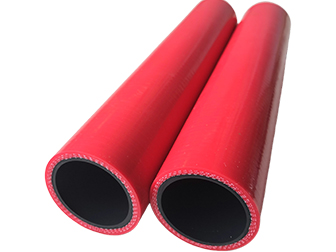
A fuel cell silicone hose may meet dimensional, temperature, and pressure requirements while still releasing substances that affect system cleanliness. For OEM purchasing teams and fuel cell engineers, evaluating this risk requires more than relying on a supplier’s low-extractables claim.
The key is to understand what was tested, how the test was conducted, and whether the results are relevant to the finished hose and its intended application. This guide explains how to evaluate material-release data and what buyers should verify before approving fuel-cell silicone hoses for use in fuel cell systems.
Key Takeaways
- Low-extractables claims should be supported by test results with clearly defined methods and exposure conditions.
- Conductivity, total organic carbon (TOC), chemical analysis, and volatile-emissions testing measure different properties.
- Finished-hose testing can complement raw-material data when the specimen and preparation method are appropriate to the test objective.
- Acceptance criteria should reflect the operating medium and agreed system requirements.
What Does "Low Extractables" Actually Mean?
Extractables are substances released from a material under specified laboratory extraction conditions. Depending on the compound formulation and manufacturing process, these may include low-molecular-weight compounds, residual processing substances, and certain siloxanes.
It is important to distinguish three related terms:
| Term | Meaning |
| Extractables | Substances released under defined laboratory extraction conditions |
| Leachables | Substances that migrate into a contacting medium under actual or simulated service conditions |
| Volatile compounds | Substances that can evaporate under particular temperature and environmental conditions |
These terms describe different aspects of material release. A liquid extraction test does not automatically establish how much material may enter an air stream, and a volatile-emissions test does not prove suitability for prolonged liquid contact.
To evaluate a low-extractables claim in fuel cell hoses, buyers need clearly defined test methods, exposure conditions, and measured properties. Product approval also requires agreed acceptance limits.
Which Tests Help Evaluate Material Release?
No single measurement provides a complete picture of material cleanliness. Different analytical methods answer different questions.
| Measurement | What It Assesses | What It Cannot Establish Alone |
| Electrical conductivity | The test liquid's electrical conductivity, which is influenced by dissolved ionic species | Low levels of all organic or nonionic extractables |
| Total organic carbon (TOC) | The overall amount of organic carbon in the test liquid | The identity of individual organic substances |
| Targeted chemical analysis | The presence and quantity of specified substances | Complete suitability under every operating condition |
| Volatile-emissions testing | Substances released into the gas phase under test conditions | Low extraction into coolant or another liquid |
For example, some fuel cell cooling systems require coolant with low electrical conductivity. If a hose releases ionic contaminants into the coolant, its conductivity may increase. However, a low conductivity result does not demonstrate the absence of all organic or nonionic substances.
TOC testing can provide an indication of overall organic contamination, while targeted chemical analysis can help identify specific substances of concern. For air-side applications, volatile-emissions testing may be more relevant to evaluating substances carried downstream by airflow.
The appropriate method depends on the contact medium and the potential contamination pathway. Results from different methods should not be treated as interchangeable.
Why Does Finished-Hose Testing Matter?
Testing the raw silicone or fluororubber compound is useful during material screening, but it may not fully represent finished fuel cell hoses.
Several factors can influence the final result.
Compound Formulation
The contact-layer material should be selected for both medium compatibility and material-release performance. Terms such as VMQ, FKM, or "high-purity silicone" describe material families or general characteristics, not the complete performance of a specific formulation.
Test evidence should correspond to the actual material grade being considered.
Curing and Post-Curing
Curing conditions affect the final material structure and residual substances. Where appropriate, post-curing may help reduce certain residual volatile compounds.
However, the use of a particular curing or post-curing process does not, by itself, establish low-extractables performance.
Hose Construction and Sample Preparation
A finished hose may contain multiple material layers and reinforcement. Testing should account for the surfaces that contact the operating medium.
Sample preparation is also important. If a test uses cut hose sections, the procedure should clarify whether exposed cut edges are included. These edges may expose reinforcement or intermediate layers that would not normally contact the fluid in service.
Finished-hose evidence is most useful when the specimen and preparation method are appropriate to the test objective and their relevance to the intended application is explained.
What Should Buyers Check in a Test Report?
Before comparing supplier results, buyers should establish the purpose of each test. A material-screening test, a laboratory extraction test, and an application-specific assessment may use different conditions and answer different questions.
When reviewing a report, check the following information:
| Item | What to Verify |
| Test purpose | Whether the test is for material screening, characterization, or application-specific approval |
| Test specimen | The material grade, hose construction, and sample preparation method |
| Extraction medium | The liquid used and its relevance to the intended application |
| Temperature and time | The documented exposure conditions |
| Surface-area-to-volume ratio | The exposed sample area relative to the test-liquid volume |
| Analytical method | The properties or substances measured and the methods used |
| Acceptance criteria | The applicable limits and the basis for those limits |
| Product traceability | Whether the tested specimen represents the proposed hose and manufacturing process |
A reported value should always be interpreted in the context of its test conditions. Two suppliers may report different results because they used different extraction media, temperatures, exposure times, sample preparation methods, or analytical techniques.
A lower numerical result does not necessarily indicate better performance if the testing conditions are not comparable.
There is no universal value that defines “low enough” for every fuel cell hose. Acceptance limits should be established according to the system requirements, operating medium, and agreed validation method.
How Should Low-Extractables Performance Be Specified?
Material cleanliness should be specified alongside the hose’s mechanical and operating requirements, rather than treated as a general product description.
For a coolant hose, the specification may need to address material release and coolant conductivity in addition to medium compatibility, temperature, pressure, and service life. For an air-side hose, volatile emissions may require separate evaluation.
A clear specification should identify:
- The intended circuit and operating medium.
- Continuous and peak operating conditions.
- Required dimensions, connections, and mechanical performance.
- Relevant material-release or cleanliness criteria.
- Test methods and acceptance limits.
- Documentation required for sample approval.
Changes to the contact-layer formulation, hose construction, or manufacturing process should also be reviewed if they could affect previously approved test results.
Fuel Cell Hose Range
Requirements for fuel cell hoses vary by circuit. Air-side and cooling-water applications may require different material constructions and cleanliness evaluations. The selected hose should therefore be assessed against the actual operating medium and relevant performance criteria.
Explore the fuel cell silicone hose range from RAINBOW Manufacturing for more product information.
Frequently Asked Questions
Can I Get Custom-Sized Fuel-Cell Silicone Hoses for Industrial Fuel Cells?
Yes. Custom dimensions and configurations may be available for industrial fuel cell applications. Options may include different diameters, lengths, bend angles, and connection designs. When low-extractables performance is required, the selected custom construction should also be evaluated for its intended operating conditions.
What Is the Difference Between Anode, Cathode, and Coolant Hoses in a Fuel Cell System?
Anode hoses handle hydrogen supply, while cathode hoses carry air to the fuel cell stack. Coolant hoses circulate cooling fluid to help regulate stack temperature. Their operating media and functional requirements differ, so they require application-specific designs.
Can Silicone Hoses Be Used in Both Air-Side and Coolant Circuits of Fuel Cell Systems?
Potentially, but suitability depends on the silicone compound, hose construction, operating medium, and service conditions. Air-side and coolant applications have different requirements, so each hose design should be evaluated for its specific circuit.