Material waste is a common cost challenge in SPC flooring manufacturing. Even when PVC resin, calcium carbonate, stabilizers, and other additives are purchased at competitive prices, excessive startup scrap, uneven sheet thickness, edge trimming, and rejected boards can reduce the profitability of every production run.
For flooring manufacturers, the most effective way to reduce material waste is to control the entire production process rather than focus on raw material costs alone. Consistent material mixing, stable extrusion, accurate thickness control, effective cooling, and synchronized cutting all contribute to better material utilization. A properly configured SPC flooring sheet extrusion line can help manufacturers maintain stable production conditions and reduce avoidable scrap.
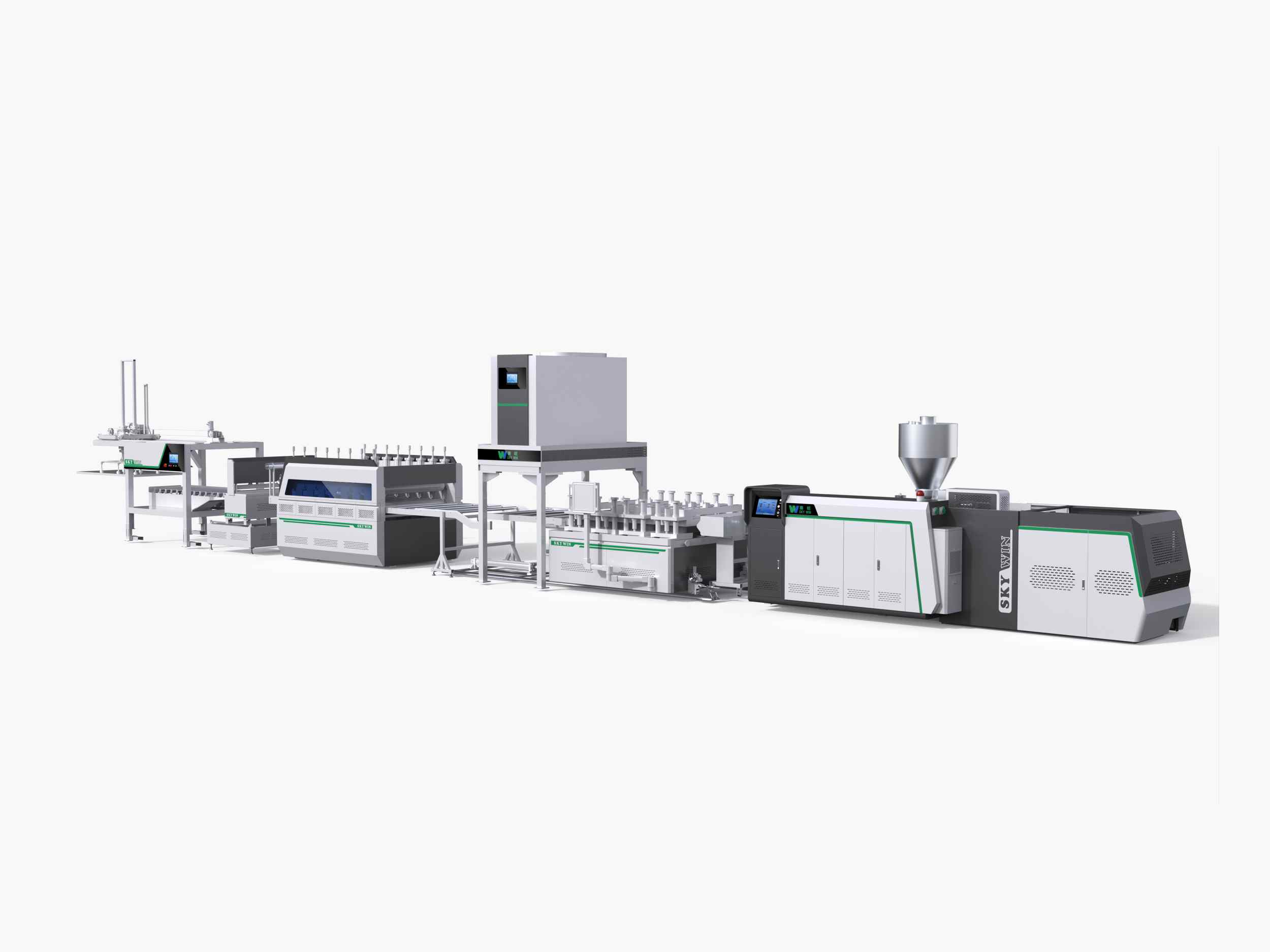
This guide explains where material waste occurs during SPC flooring production, how manufacturers can identify the main causes, and which process improvements can help lower scrap rates without compromising finished flooring quality.
Where Does Material Waste Occur in SPC Flooring Manufacturing?
Material waste can occur at several stages of SPC flooring production. Identifying the source is the first step toward reducing it. A factory that records waste only at the end of production may overlook the process responsible for most of the loss.
| Production stage | Common source of waste | Recommended control |
|---|---|---|
| Material preparation | Incorrect weighing, inconsistent mixing, material spillage | Standardize recipes and verify weighing accuracy |
| Extrusion startup | Unstable melt flow, temperature fluctuations, off-specification sheets | Use a repeatable startup procedure |
| Sheet forming | Uneven thickness, poor dimensional consistency | Check die settings, roller conditions, and process stability |
| Cooling and handling | Warping, deformation, scratches, and rejected sheets | Optimize cooling and sheet transport |
| Edge trimming and cutting | Excessive edge removal and inaccurate cutting lengths | Improve width control and synchronize downstream equipment |
These problems should not automatically be treated as raw material issues. For example, a sheet that becomes warped after cooling may originate from unstable extrusion or uneven temperature distribution. Replacing raw materials without identifying the underlying cause may increase costs without reducing waste.
Keep Raw Material Mixing Consistent
SPC flooring compounds commonly contain PVC resin, calcium carbonate, stabilizers, and other processing additives. The formulation determines important properties such as rigidity, density, processing behavior, and dimensional stability. Inconsistent material preparation can make the extrusion process harder to control and increase the number of rejected sheets.
Manufacturers can improve material utilization by following several practical measures:
- Use a documented formulation with clearly defined proportions for every production batch.
- Check weighing equipment and verify that each ingredient is added in the correct quantity.
- Maintain consistent mixing procedures, including mixing time and temperature where applicable.
- Keep raw materials properly stored and follow supplier recommendations for handling.
- Record batch numbers and processing results so that material-related defects can be traced.
Do not change the calcium carbonate loading, stabilizer package, or other formulation components simply to reduce costs. Any formulation adjustment should be evaluated for its effect on processability, sheet quality, mechanical performance, and the finished flooring specification.
A well-designed extrusion system also matters. SKY WIN's PVC/WPC flooring base material extrusion line uses a conical twin-screw configuration designed for mixing and dispersion of the material compound. The appropriate configuration should be selected according to the actual formulation, sheet dimensions, and production requirements.
Reduce Scrap During Extrusion Startup
Startup scrap occurs when the production line is not yet producing sheets that meet the required specifications. Material may need to be discarded while temperatures stabilize, melt flow becomes consistent, and the sheet reaches the correct width and thickness.
To reduce startup waste, establish a standard operating procedure that covers temperature settings, screw speed, feeding conditions, calender settings, haul-off speed, and cooling conditions. Operators should use validated settings as a starting point and make controlled adjustments rather than changing several parameters at once.
A practical startup procedure should include:
- Confirm that the selected formulation and material batch are correct before feeding.
- Check the extruder, die, calendering section, cooling equipment, and cutting system before startup.
- Allow the process to stabilize according to the equipment manufacturer's operating instructions.
- Measure sheet thickness and width at defined intervals during startup.
- Record the amount of startup scrap and the time required to reach acceptable production quality.
Factories should also document successful production settings for frequently manufactured flooring specifications. When changing colors, formulations, sheet thicknesses, or product structures, operators can use these records to reduce trial-and-error adjustments. Settings must still be checked against current material and machine conditions.
Control Sheet Thickness and Width to Reduce Material Loss
Uneven sheet thickness can cause quality failures and unnecessary material consumption. If the sheet is too thick, the factory may use more compound than the product specification requires. If it is too thin or varies across its width, the material may fail inspection or create problems during downstream processing.
Thickness and width control should therefore be treated as both quality-control measures and material-cost management tools.
Manufacturers should regularly inspect the extrusion die, calendering rollers, and relevant process settings. They should also verify that the sheet remains stable as it moves through the haul-off and cooling sections. Measurements taken only from the center of the sheet may miss thickness variations near the edges, so sampling should cover the width of the product where practical.
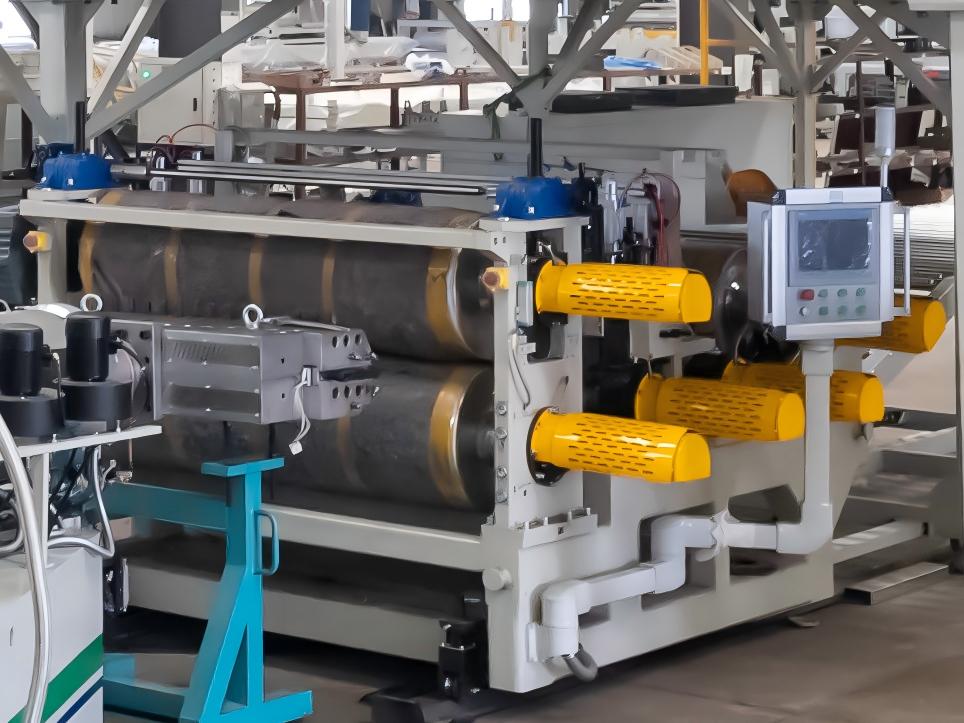
SKY WIN's flooring and plastic extrusion machine range includes equipment for different flooring production requirements. When evaluating a line, manufacturers should confirm how the proposed configuration will handle their target sheet width, thickness, formulation, and required output.
The goal is not simply to minimize thickness. It is to consistently meet the product specification without using unnecessary material or generating out-of-tolerance sheets.
Optimize Cooling to Prevent Rejected SPC Sheets
Cooling helps an extruded SPC sheet maintain its dimensions and stability before further processing. If cooling is insufficient or uneven, the sheet may deform, develop internal stress, or become difficult to handle accurately. These problems can result in rejected material or additional trimming.
To reduce cooling-related waste, manufacturers should check that the cooling system has sufficient capacity for the selected production rate and sheet dimensions. They should also monitor cooling conditions across the sheet and verify that the haul-off speed is compatible with the extrusion and calendering sections.
When defects appear, record where they first become visible. If the sheet is uniform at the die exit but deforms after cooling, the cooling and handling stages deserve closer inspection. If thickness or surface irregularities are already present before cooling, the issue may originate earlier in the process.
SKY WIN's SPC/PVC flooring sheet extrusion line includes cooling equipment as part of the integrated production configuration. The actual cooling arrangement and operating parameters should be matched to the formulation, line output, and finished sheet requirements rather than selected by output capacity alone.
Minimize Edge Trimming and Cutting Waste
Edge trimming is a normal part of many SPC flooring sheet production processes, but excessive trimming can consume a significant amount of material over time. Cutting inaccuracies can also produce off-specification lengths or increase the number of rejected pieces.
Manufacturers can reduce these losses by focusing on three areas.
Improve sheet width consistency. Stable forming conditions help reduce uneven edges and make it easier to maintain the required finished width. If operators must repeatedly remove large amounts of material, investigate the source of the width variation instead of treating trimming as the only solution.
Synchronize the production line. The extruder, calender, haul-off, edge trimmer, and cutter must operate as a coordinated system. Speed mismatches or unstable sheet movement can affect cutting accuracy and finished dimensions.
Review cutting allowances. Confirm that trimming allowances and cutting lengths reflect the actual product specification. Avoid unnecessarily large allowances, but do not reduce them below what is needed to maintain acceptable product quality.
Side-trim recycling may be an option in some facilities, but it should only be used when the material is clean, traceable, and suitable for the approved formulation. Regrind can behave differently from virgin material, and uncontrolled reuse may affect color, processing stability, or finished product performance. Follow the material supplier's recommendations and validate any recycling procedure before implementing it at scale.
Choose an SPC Flooring Extrusion Line That Matches Production Needs
Equipment selection influences material utilization because the extrusion line must handle the intended formulation, sheet dimensions, and production rate consistently. A machine with a high advertised output is not necessarily the most economical choice if downstream equipment cannot keep pace or if the required product specification is difficult to maintain.
Before choosing an SPC flooring extrusion line, manufacturers should evaluate:
- Target sheet thickness and width.
- Required production output under the intended formulation and product specifications.
- Mixing and plasticizing requirements for PVC resin, calcium carbonate, and additives.
- Calendering, lamination, cooling, edge trimming, and cutting configuration.
- Ease of adjusting and monitoring process parameters.
- Maintenance requirements, operator training, and technical support.
SKY WIN's SPC/PVC flooring sheet extrusion line uses a high-torque conical twin-screw extruder and integrates sheet-forming, cooling, trimming, haul-off, and cutting equipment. The line configuration also lists lamination equipment and a five-roll laminator. These features should be assessed in relation to the manufacturer's planned production process and required finished product quality.
When requesting a quotation, provide the intended formulation, sheet dimensions, target output, and lamination requirements. This gives the equipment supplier a more useful basis for recommending a suitable configuration than output capacity alone.
Measure Material Waste With Production Data
Waste reduction becomes more effective when the factory measures it consistently. Without records, operators may notice fewer visible defects without knowing whether total material consumption has actually improved.
A useful starting point is to calculate the scrap rate:
Scrap Rate (%) = Scrap Material Weight ÷ Total Material Input Weight × 100
For example, if a production run uses 1,000 kg of material and generates 50 kg of scrap, the scrap rate is 5%. This is an illustrative calculation, not a recommended industry benchmark.
Factories should define clearly which losses are included in the calculation, such as startup scrap, rejected sheets, edge trims, and cutting waste. Reusable trim that is returned to production should be tracked separately so that the same material is not counted as both waste and fresh input.
In addition to the scrap rate, record the following indicators:
- Startup scrap per production run.
- Rejected material by defect type.
- Edge-trim weight compared with total material input.
- Average time required to reach stable production after a changeover.
- Good product output per kilogram of material consumed.
Review these indicators by product specification, production shift, and material batch. This helps identify whether the largest losses come from startup adjustments, inconsistent material preparation, equipment settings, or downstream handling. Once the main cause is confirmed, the factory can test a specific corrective action and compare the results against its baseline.
A Practical Plan for Reducing SPC Flooring Production Waste
Factories do not need to change every process at once. A staged approach makes it easier to identify which improvements deliver measurable results without introducing unnecessary production risks.
- Establish a baseline: Measure total material input, startup scrap, rejected sheets, edge trims, and good product output.
- Identify the largest loss: Separate scrap by production stage and defect type rather than relying only on total waste figures.
- Standardize material preparation: Check formulation records, weighing accuracy, and mixing consistency.
- Stabilize extrusion: Review startup procedures, process temperatures, material feeding, and sheet-forming conditions.
- Check downstream coordination: Verify cooling, haul-off, trimming, and cutting settings.
- Measure the result: Compare the scrap rate and good product output before and after each controlled adjustment.
Reducing SPC flooring material waste is a continuous improvement process. The most reliable gains come from identifying the actual cause of scrap, applying a controlled adjustment, and confirming the result with production data. Material savings should never come at the expense of flooring quality, dimensional stability, or customer specifications.
Frequently Asked Questions
How can manufacturers reduce material waste in SPC flooring production?
Manufacturers can reduce waste by standardizing raw material mixing, stabilizing extrusion startup, controlling sheet thickness and width, optimizing cooling, and coordinating trimming and cutting. Tracking scrap by production stage helps identify the most effective improvement.
What causes high scrap rates in SPC flooring manufacturing?
Common causes include inconsistent material formulation, unstable melt flow, thickness variation, sheet deformation during cooling, excessive edge trimming, cutting errors, and frequent production changeovers.
Can an SPC flooring extrusion line help reduce material waste?
A properly configured SPC flooring extrusion line can help improve material utilization by maintaining stable extrusion, consistent sheet forming, effective cooling, and coordinated downstream processing. Actual results depend on the formulation, machine configuration, operating conditions, and production management.
How does sheet thickness control reduce material consumption?
Consistent thickness helps prevent overuse of compound and reduces the risk of rejected sheets. Manufacturers should measure thickness across the sheet width and maintain the required product tolerance rather than simply reducing thickness.
Can SPC flooring edge-trim waste be reused?
Some clean edge-trim material may be reusable if it is compatible with the approved formulation and processing requirements. Reuse should be controlled and validated because contamination or changes in material properties can affect finished flooring quality.
How should a factory measure its SPC flooring scrap rate?
Divide the defined scrap material weight by total material input weight and multiply by 100. Establish consistent rules for startup waste, rejected sheets, edge trims, and recycled material so that production runs can be compared accurately.
Is a higher extrusion output always more cost-effective?
No. A higher rated output does not automatically mean lower production costs. The line must maintain acceptable product quality, and the cooling, haul-off, trimming, and cutting sections must be able to handle the output without increasing scrap.
What information should manufacturers provide when selecting an SPC flooring extrusion line?
Provide the target sheet width and thickness, formulation, required output, flooring structure, lamination requirements, and expected production conditions. These details help the supplier assess whether the proposed line fits the intended application.
What is the first step in a material waste reduction program?
Measure current material input and scrap, then classify the losses by source. This establishes a baseline and helps the factory prioritize the process changes most likely to improve material utilization.